Our Process

From the first call to work running in your business.

Four steps. The first two cost you nothing and end with your own numbers read back to you. Here is the whole thing, including what it costs and what happens if you stop.

Day 0A 15 minute call
Week 1 to 2A working session
Free · nothing to sign but an NDA we sign

The four steps

How it goes, in full.

Two of these happen before you owe us anything. The line partway down shows exactly where that changes.

Day 0

A 15 minute call

A conversation, not a pitch. How the business got where it is, what a normal Tuesday looks like, and which part of the day you would hand off first if you could.

You leave withA one page questionnaire: the four numbers, plus whatever you have on where leads come from. Rough is fine, blank is an answer, and anything you are unsure of just gets marked rough.
AndA one way confidentiality commitment, signed by us, not you. Say the word and it comes first, before you say a number.
You oweNothing.
Week 1 to 2

A working session, free

We sit down with whatever you sent back. Rough numbers are fine; the gaps tell us as much as the figures. We read them back to you and do the arithmetic out loud.

You leave withObservations and options, and which of the four moves is worth the most in your business specifically.
You do not getA proposal, a deck, or a price.
If we cannot helpWe say so in the room, and the session is still free.
Your numbersRead by the three of us and nobody else. Never shared, never benchmarked against a named competitor, never put on a list.
Everything above this line is free

Nothing you have seen so far has an invoice attached to it.

Week 3

Scope the first fix

One piece of work goes first: the one that is cheapest to run and quickest to read. Usually the phone, the quote follow up, or the past customer list, because each shows up in your numbers within weeks.

PricedAfter we have seen your numbers, against what the move is worth to you. We do not sell hours and we do not sell a plan tier.
Written downOn one page, before anything goes live. If it is not on the page, it is not happening.
What we needA read only look at the software you already run, and one person who can say yes. Not before this point.
Metered separatelyThe phone line and texting, at cost, itemized on every invoice. You get the expected range before anything runs.
Your softwareStays yours, stays as it is. We read from it and write back to it. No CRM at all and we will set one up.
If you stopData, contacts, written content and domain come back to you.
Every Monday

A set of eyes, every week

The first workflow goes live on the software you already run. The Monday page starts the week your data is connected, and it is the same page with the same definitions every week after that.

Every MondayThe four numbers, this week against the same week last year, what ran, and what we did about anything that moved the wrong way.
Moves the wrong wayYou hear from us by text, before it becomes a quarter.
Needs a personIt lands as a normal text in Atlas Connect, on the phone your crew already carries, with the context attached. Reply from the truck and the record updates itself.
By month threeWe are usually catching things nobody was looking at, and the second piece of work is obvious.

Definitions

The four numbers, defined.

Every number on your Monday page, and on your questionnaire, means this. Same definitions in week one and in month three, so a number you send today still means something later.

01

New leads a month

Everyone who asked for a quote, a visit or a price in a month, whether they came by phone, form, text or a referral.

Where it livesThe phone log, the CRM, the form inbox. A rough count from last month is enough.
02

New sales from them

How many of those leads became a paying job in the same month. Not repeat customers, not upsells on existing jobs. New.

Where it livesClosed jobs or invoices for first time customers. If you cannot split new from repeat, send the total and say so.
03

What it costs you to sell

Over the last twelve months: salespeople, commissions, sales and marketing managers, the agency, every ad dollar. Not office overhead, not your own pay.

Where it livesPayroll for anyone whose job is selling, plus the marketing lines on the P&L. Your bookkeeper can pull it in ten minutes.
04

Gross margin

The percent left after materials, crew and equipment on the job. Before office, trucks, insurance and you.

Where it livesThe P&L, as gross profit divided by revenue. If your books do not split job costs out, say so; that is one of the things the working session fixes.
leads ÷ new salesYour close rate
cost to sell ÷ new salesWhat a new customer costs you
gross marginWhether that customer was worth winning

Four numbers, one question: what does a new customer cost you, and what is that customer worth.

Six pieces of work

What could go first.

Each one runs in the background on the tools you already have. One goes first, chosen by which is cheapest to run and fastest to read in your numbers. The trade usually decides which.

01

Answer every call

Calls after 5 go to voicemail. The ones who don't leave a message call the next company on the list.

Answered and booked while the truck is still running, including the ones that come in at nine at night.

Moves
01 · New leads
02

Chase every quote

Estimates go out, nobody follows up past the second try, and the ones from four months ago are just gone.

Day 1, 3, 7, 14 and 30, on this week's estimates and on the ones sitting in the drawer since March.

Moves
02 · New sales
03

Bring past customers back

The people most likely to buy again are the ones nobody has called in a year.

Every Monday the list builds itself: customers serviced this month last year who have not been back.

Moves
02 · New sales
04

Know which ads made the phone ring

Paid search gets the credit for customers who were coming back anyway.

Every lead is matched to the customer record the day it arrives, so the spend question lands with a number attached.

Moves
03 · Cost to sell
05

One page where you stand

The numbers exist somewhere, in three systems and a bookkeeper's head, never on the same page.

The four numbers against the same week last year, what ran, and what moved, every Monday at 7:00.

Moves
All four
06

Keep customers warm

The only time customers hear from you is when you want something.

A thank-you after the job, a review ask, a seasonal note, on the cycle they already buy on.

Moves
04 · Gross margin

Atlas Connect

Your team gets it on their phone.

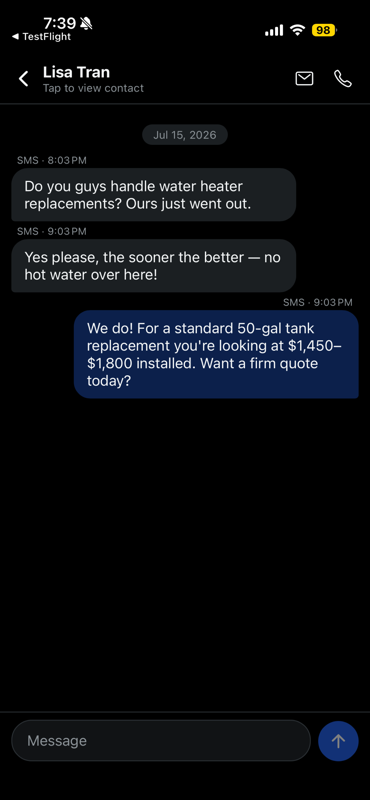
Atlas Connect puts every conversation the work produces, calls, texts and email, in one thread per customer, on the phone your crew already carries. When the agent hands a decision to a person, this is where it lands.

  • One thread per customer: texts, email and calls together, with the history
  • The hand off from the agent arrives as a normal text, with the context attached
  • Reply from the truck; the customer record updates itself
  • Your team's numbers stay yours; the app rides on the same lines
Download on the App Store Get it on Google Play
Atlas Connect on a phone: a text thread with a customer asking about a water heater replacement, and the reply with a price range and an offer of a firm quote
A customer thread in Atlas Connect. The reply went out from the app, and the record kept it.

Start with the 15 minutes.

You leave with the questionnaire and the confidentiality commitment. The working session is free either way.